
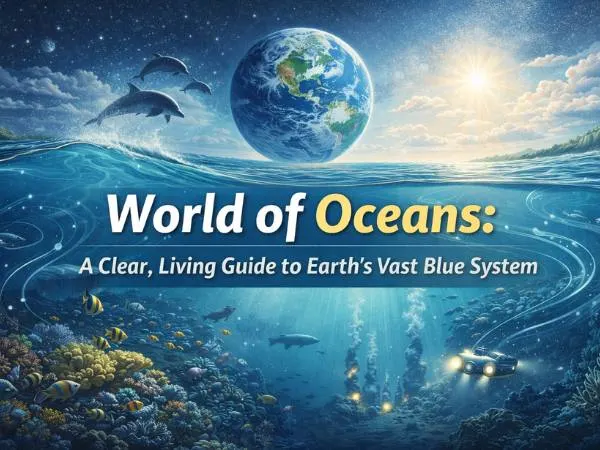
When people say world of oceans, they usually mean more than water on a map. Oceans shape climate, feed billions, move heat around the planet, and hold most life on Earth by volume. They also spark curiosity through maps, books, games, aquariums, and global events like Ocean Day. Put simply, oceans keep the planet running while staying mostly unseen.
This guide explores the world of oceans in a grounded way. We’ll move from maps and names to life zones, currents, culture, and learning tools. You’ll see how oceans connect places, why they matter daily, and how people experience them through science, education, and play.
What the World of Ocean Really Means
The phrase points to a single, connected system. Oceans are not separate tubs of water. They form one circulating body that wraps the planet. Currents carry heat, salt, and nutrients across vast distances. A change in one region affects many others.
That connection explains why storms intensify, fisheries shift, and coastlines change. Oceans act as Earth’s main regulator.
World of Ocean Map: Seeing the System
Maps help make sense of scale. A world of ocean map shows how water covers about 71 percent of Earth’s surface. It also reveals how continents split the surface while currents link everything below.
The Five Named Oceans
Most modern maps label five oceans:
- Pacific Ocean – the largest and deepest
- Atlantic Ocean – central to global trade routes
- Indian Ocean – strongly shaped by monsoon systems
- Southern Ocean – encircles Antarctica and drives cold currents
- Arctic Ocean – the smallest and shallowest
These names help with navigation and study. Physically, the water remains connected.
also read : – Which Planet Is Closest to the Sun
World of Ocean Name: Why Naming Matters
Names give structure. They help sailors, scientists, and students talk about regions with shared traits. Temperature patterns, currents, and ecosystems vary by area, so names provide a useful shorthand.
That said, boundaries on maps are human-made. Currents and life do not stop at lines.
Layers of the Ocean: From Sunlight to Darkness
Oceans are vertical worlds. Light fades quickly with depth, creating distinct zones.
Sunlit Surface Zone
This top layer supports photosynthesis. Phytoplankton here form the base of marine food webs and produce a large share of Earth’s oxygen.
Twilight Zone
Light drops off. Animals adapt with large eyes, reflective bodies, or bioluminescence. This zone plays a major role in carbon cycling.
Midnight Zone and Below
Permanent darkness. Cold temperatures. Extreme pressure. Life survives through slow metabolisms and specialized feeding.
These layers show how the world of oceans holds many habitats stacked on top of each other.
Life in the World of Oceans
Marine life ranges from microscopic plankton to the largest animals ever known. Diversity rises near coasts and coral reefs, where sunlight and nutrients meet.
Key Groups You’ll Find
- Plankton – tiny drifters that drive food webs
- Invertebrates – corals, jellyfish, mollusks
- Fish – from reef dwellers to open-water hunters
- Marine mammals – whales, dolphins, seals
Each group fills a role that keeps ecosystems stable.
Coral Reefs: Cities of the Sea
Reefs cover a small area yet support a huge share of marine species. They protect shorelines, support fisheries, and attract tourism. Warm, clear water and stable conditions allow corals to build massive structures over time.
Stress from warming, pollution, and overuse threatens reefs. Their health reflects wider ocean balance.
Ocean Currents: The Planet’s Conveyor
Currents move heat around the globe. Warm currents raise temperatures along some coasts. Cold currents cool others. This circulation affects rainfall, storm paths, and even agriculture far inland.
One well-known system is the global conveyor, which links surface and deep currents into a slow, planet-spanning loop.
Oceans and Climate Control
Oceans absorb a large share of excess heat and carbon dioxide from the atmosphere. This buffering slows warming but comes at a cost. Heat stress alters ecosystems. Absorbed carbon changes water chemistry, affecting shell-building organisms.
Understanding oceans is essential to understanding climate.
World of Ocean Day: Why It Exists
Each year, people mark World of Ocean Day to raise awareness about ocean health. Events focus on education, conservation, and community action. The day reminds us that daily choices—food, energy, waste—connect back to the sea.
Awareness leads to better decisions.
also read : – Costco Strike: What Really Happened, Where It Spread, and Why It Shook One of America’s Most Trusted Retailers
World of Ocean Book: Learning Through Pages
Books open the ocean to readers who may never dive. A good world of ocean book blends maps, photos, and stories to explain processes in simple terms.
Popular themes include:
- exploration history
- deep-sea discoveries
- marine species guides
- conservation challenges
Books turn scale into something graspable.
World of Ocean Game: Learning Through Play
Games help people understand complex systems by interaction. A world of ocean game might involve managing fisheries, exploring reefs, or navigating currents. When players see cause and effect—overfishing reduces stocks, pollution harms reefs—learning sticks.
Games translate science into experience.
World of Ocean Shanghai: Bringing the Sea to the City
Large aquariums let inland audiences meet marine life up close. World of Ocean Shanghai is an example of a city attraction designed to showcase species, habitats, and conservation messages.
Modern aquariums aim to balance display with education and animal welfare, helping visitors connect daily life to ocean systems.
Oceans of Fun: Culture and Entertainment
The phrase world’s oceans of fun pops up in parks, media, and family attractions. Fun draws attention. Attention opens the door to learning. When entertainment includes accurate context, it can inspire care rather than distraction.
The key is pairing wonder with responsibility.
Ocean Exploration: How We Learn More
Despite satellites and sensors, much of the ocean remains unmapped. Exploration uses ships, submersibles, and autonomous vehicles to study seafloor features and deep habitats.
Each mission adds pieces to the picture: new species, unknown ridges, hidden vents.
Technology Shaping Ocean Study
Modern tools include:
- remote sensing satellites
- underwater drones
- acoustic mapping
- long-term sensor arrays
These tools track temperature, chemistry, and life patterns over time, revealing trends that short visits miss.
Oceans and Human History
Seas shaped trade, migration, and culture. Coastal societies relied on tides and seasons. Navigation spurred mapmaking and science. Stories of exploration still shape how people view oceans today.
History shows a long relationship built on reliance and respect—sometimes broken, sometimes renewed.
Food From the Sea
Seafood feeds millions. Sustainable management matters. Healthy fisheries depend on science-based limits, habitat protection, and fair practices.
Aquaculture adds supply but needs careful planning to avoid pollution and disease.
Pollution and the World of Oceans
Plastic, chemicals, and runoff threaten marine life. Waste travels far through currents, concentrating in some regions. Solutions focus on reduction, reuse, cleanup, and better systems on land.
Small actions add up when multiplied across populations.
Protecting the World of Oceans
Protection takes many forms:
- marine protected areas
- sustainable fishing rules
- habitat restoration
- climate action
Success depends on cooperation across borders since water connects nations.
also read : – White Last Names: History, Meaning, and the Stories Hidden Inside Familiar Surnames
How Education Changes Outcomes
People protect what they understand. Maps, books, games, and exhibits translate complex science into clear stories. Education builds long-term care rather than short-term interest.
Learning leads to stewardship.
Oceans in Everyday Life
Oceans affect weather forecasts, food prices, travel routes, and even the air we breathe. Their influence reaches far beyond coastlines.
When you notice patterns—storms, seasons, supply chains—you’re seeing ocean effects at work.
The Future of the World of Oceans
The future depends on choices made now. Warming, acidification, and overuse pose challenges. Innovation, policy, and public support offer paths forward.
Oceans have resilience. Given space and time, they recover.
How You Can Connect With Oceans
You don’t need to live by the sea. You can:
- learn through books and maps
- support sustainable seafood
- reduce waste
- visit aquariums that teach conservation
Connection starts with curiosity.
Final Words
The world of oceans is a single, living system that shapes Earth every day. Maps show its scale. Books explain its workings. Games and exhibits make it tangible. Global days remind us to care.
Understanding oceans turns awe into action. And action keeps the system that sustains us in balance.
FAQs: World of Oceans
What does world of oceans mean
It refers to Earth’s connected ocean system and the life, processes, and culture linked to it.
How many oceans are there
Most maps show five: Pacific, Atlantic, Indian, Southern, and Arctic.
What is a world of ocean map
A map that shows global ocean regions, currents, and boundaries.
What is World of Ocean Day
A global awareness day focused on ocean education and protection.
Are ocean games useful for learning
Yes. Interactive play helps people understand cause and effect in marine systems.

